
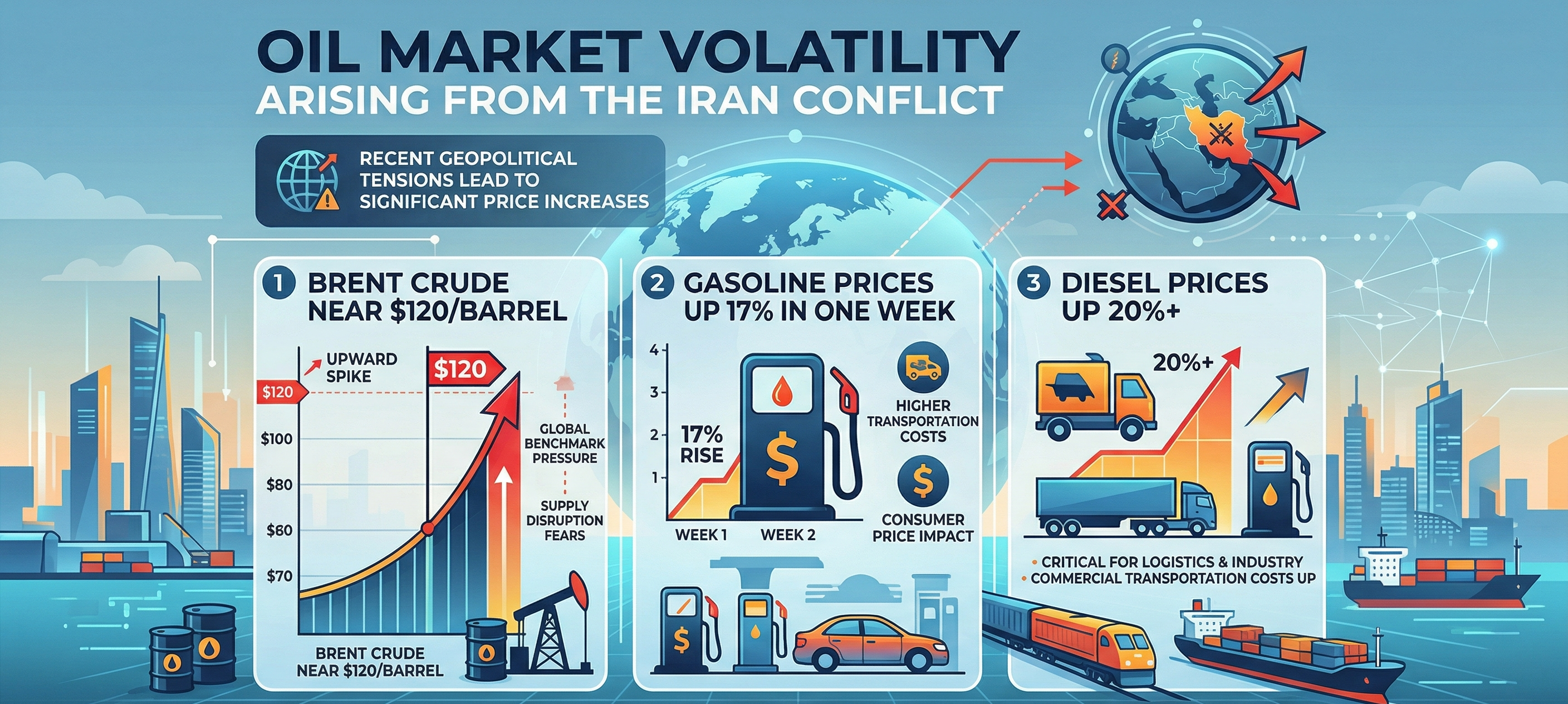
March didn’t just break records. It exposed how slow fuel operations still are. With Brent crude pushing toward $120 and national diesel averages hitting $5.37, the gap between market movement and price execution has never mattered more. In this market, that gap is where margin is won or lost. In this month’s Dispatch, we break down what actually happened in March and why operating at market speed is no longer optional.
Speed is the New Margin: Navigating the Most Volatile Month in Years
Over the past month, refined product markets didn’t just move. They accelerated. Following escalation in the Iran conflict, Brent surged toward $120 per barrel as markets priced in potential disruption through the Strait of Hormuz. But while crude grabbed headlines, the real impact hit downstream and it hit faster. The difference between reacting in minutes versus hours is now the difference between capturing margin and giving it away.
The Downstream Shockwave
March wasn't just volatile. Everything was compressed.
- RBOB Gasoline: +18% in 10 days
- ULSD (Diesel): $5.37/gal national avg
- Brent Crude: reached $119.50/bbl
This wasn’t a gradual shift. It was a rapid repricing of the entire fuel value chain.
Volatility Isn’t the Problem. Lag Is.
Volatility creates opportunity. Lag destroys it.
The challenge today is not understanding the market. It is keeping up with it.
When futures, rack prices, freight, and local competition are all moving at once, the pricing window collapses. What used to be a daily process is now an intra-day decision cycle. Most teams are still operating at the speed of 2016 while the market is moving at the speed of 2026. That gap is where margin disappears.
Why "Manual" is Now "Risky"
If your team is still manually checking portals and updating spreadsheets, you are not just behind. You are exposed. In a market this fast, the entire supply chain can shift before you’ve even finished your morning coffee. And its not just pricing. This is a supply and execution problem: Where to lift. What loads to shift. How to plan for mid-day changes. You cannot solve a real-time market with batch processes.
This is why we built Gravitate.
Gravitate is built for market-speed execution across pricing, supply, and dispatch.
Our platform continuously ingests futures data, rack movements, supply constraints, and logistics inputs, then acts on them in real time.
While most teams are still reacting, Gravitate customers already have:
- The right price live
- The optimal supply decision in motion
- Dispatch aligned with current market conditions
This is not about reacting faster. It is about operating differently.
The Bottom Line: When markets move this fast, being reactive is just another way of saying "too late". Speed is not longer a competitive advantage. It is the cost of staying in the game.
Let's Talk Strategy: Two Shows, One Message
After a record-breaking March, April is the time to stabilize and scale.
We will be at M-PACT (April 14-16) and SIGMA Spring (April 28-30) connecting with operators who are rethinking how fuel gets priced, sourced, and delivered in a real-time market.

If your team is still reacting in hours while the market moves in minutes, you are giving away margin every day.
Let’s fix that.